

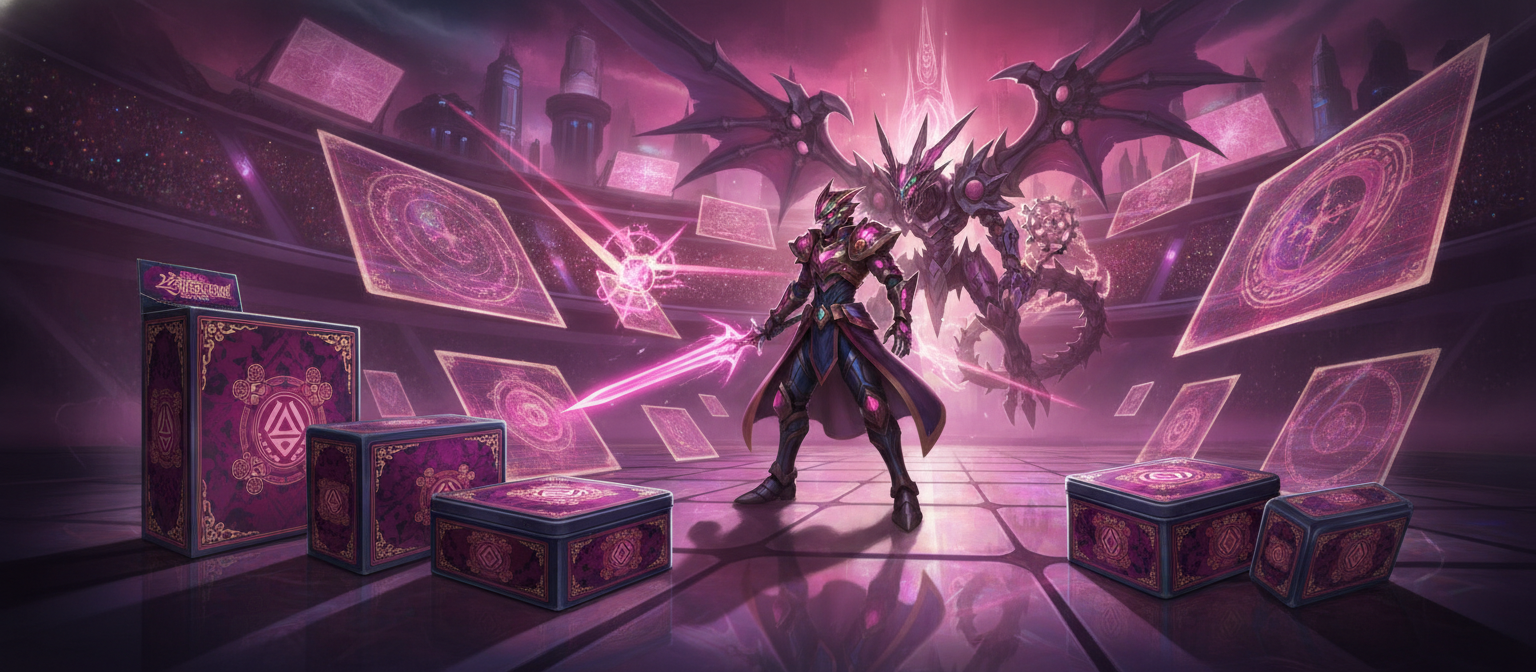
In Yu-Gi-Oh! the threat is often more impactful than the actual execution. This concept is crucial for strategic success.
- A threat forces the opponent to expend resources or alter their plans before a move is even played.
- Similar to chess, where a piece's position signals potential actions, Yu-Gi-Oh! players utilize face-down cards and deck knowledge.
- Skillful resource management and understanding the psychology of the duel are keys to mastery.
- Master the art of threat to gain card advantage and tempo, and to outsmart your opponents.
In the dynamic and complex universe of Yu-Gi-Oh!, it's about much more than just summoning the strongest monsters or activating the most devastating Spells. True mastery often lies in the ability to put the opponent under threat, forcing them to sacrifice resources or make misplays even before a card's full effect is revealed. This concept of strategic depth is a cornerstone of advanced gameplay and is closely intertwined with resource management and psychological warfare. Just as in chess, where the mere presence of a piece on a key square poses a danger, so too in Yu-Gi-Oh! can the potential action of a card or a deck have a profound impact on the course of the game. Understanding and applying these principles is crucial to gaining the upper hand in any duel.
Understanding the Power of Threat in Yu-Gi-Oh!
In Yu-Gi-Oh!, "threat" refers to the potential danger posed by a card, a game state, or knowledge of the opponent's deck, even before that danger is actually realized. This principle, often referred to as "the threat is stronger than the execution," is a central element of strategic depth. It describes how the mere possibility of a strong move can force the opponent to react in a way that depletes their resources or disrupts their plans.
A threat can manifest in various ways:
- Visible Threats: A powerful monster with a disruptive Quick Effect on the field, such as Borreload Savage Dragon, poses an immediate and obvious danger. The opponent knows that this monster could negate one of their actions and must account for this in their plays.
- Hidden Threats: A face-down Spell or Trap is a classic form of threat. The opponent must assume it could be a powerful card like Infinite Impermanence or Evenly Matched, which would severely disrupt their strategy. This uncertainty forces them to be cautious or to make risky "tests" to reveal the face-down card.
- Implicit Threats: Knowledge of the opponent's deck type is a powerful, implicit threat. If you know your opponent is playing a deck known for its Hand Traps like Ash Blossom & Joyous Spring, you will plan your search and summoning effects accordingly and possibly choose alternative routes. The threat of these cards is always present, even if they are not visible.
Understanding these different types of threats allows players not only to optimize their own moves but also to anticipate and manipulate those of their opponent. It's about creating a scenario where the opponent is forced to react to imaginary or potential dangers, thereby giving you an advantage in resource and tempo management.
Chess and Yu-Gi-Oh!: A Striking Parallel
The strategic commonalities between chess and Yu-Gi-Oh! are deeper than one might initially suspect, especially when it comes to the concept of threat. The saying "the threat is stronger than the execution" originated in chess and finds an astonishingly precise equivalent in Yu-Gi-Oh!.
In chess, threats are omnipresent. A piece threatens to occupy a square, capture another piece, or attack the king. These "passive threats" force the opponent to invest valuable moves and pieces to ward them off or circumvent them, even if the actual capture is never made. The mere possibility of an attack can put a player in a disadvantageous position, known as "zugzwang," where every conceivable move worsens the situation.
In Yu-Gi-Oh!, these parallels manifest in similar ways:
- Field Control: A powerful Link Monster pointing arrows to the opponent's Extra Monster Zones threatens their ability to summon more Extra Deck monsters. This restricts their options, similar to how a Rook in chess controls an entire rank or file.
- Hidden Resources: A face-down Spell/Trap Card is like a chess piece whose actual function is not yet known, but whose potential poses a danger. The opponent must consider the possibility that it is a game-changing card and react accordingly.
- Anticipation and Planning: Both games require players to think several moves ahead and anticipate the opponent's potential reactions. A threat is generated not only by one's own sequence of moves but also by understanding how the opponent might react to them.
- Resource Commitment: In chess, a threat forces the opponent to move a piece or defend another piece. In Yu-Gi-Oh!, a threat forces the opponent to sacrifice Hand Cards (e.g., Hand Traps), field resources (destruction effects), or even Life Points to avert a potential danger.
Tomorrow morning, it's time again: The duel begins, the tension rises. But true masters of Yu-Gi-Oh! know that victory often lies not in the direct execution of a powerful play, but in the subtle art of manipulating the opponent through "threats." This article, inspired by profound discussions on "The Art of Playing Under Threat," delves deep into the psychological and strategic dimensions of this concept. We will explore how the mere possibility of a devastating move – the threat – can force the opponent to sacrifice valuable resources or change their plans even before the move is executed. From parallels to chess to concrete deck strategies, you will learn how to recognize, create, and utilize threats to your advantage.
Understanding the Power of Threat in Yu-Gi-Oh!
In Yu-Gi-Oh!, a threat is the potential danger posed by a card, a game state, or knowledge of the opponent's deck, even before that danger is actually realized. This principle, often referred to as "the threat is stronger than the execution," is a central element of strategic depth. It describes how the mere possibility of a strong move can force the opponent to react in a way that depletes their resources or disrupts their plans. It's about creating a situation where the opponent is more afraid of what could happen than what has already happened.
A threat can manifest in various ways:
-
Visible Threats: A powerful monster with a disruptive Quick Effect on the field, such as Borreload Savage Dragon, poses an immediate and obvious danger. The opponent knows that this monster could negate one of their actions and must account for this in their plays. They must either expend an additional card to remove Borreload Savage Dragon or adjust their playstyle to avoid its negation. The threat here is tangible and forces a direct reaction.
Borreload Savage Dragon
| Statistic | Value |
|---|---|
| Level | 8 |
| Attribute | DARK |
| Type | Dragon / Synchro / Effect |
| ATK / DEF | 3000 / 2500 |
| Material | 1 Tuner + 1+ non-Tuner monsters |
| Effect | When summoned: Equip 1 Link Monster from your GY. Place 1 Borrel Counter on this card for each Link Marker the equipped monster has. Negate effects. |
This Dragon is a prime example of a visible, active threat. Its ability to negate any effect as long as it has Borrel Counters forces the opponent to carefully time their most important effects or first find a way to remove *Borreload Savage Dragon* from the field. The fear of its negation can lead the opponent to not activate important "engine" cards or make weaker plays to "bait" the negation.
-
Hidden Threats: A face-down Spell or Trap is a classic form of threat. The opponent must assume it could be a powerful card like Infinite Impermanence or Evenly Matched, which would severely disrupt their strategy. This uncertainty forces them to be cautious or to make risky "tests" to reveal the face-down card. The strength of the face-down card lies in its unknown potential. Even a "bluff" card can generate value here.
-
Implicit Threats: Knowledge of the opponent's deck type is a powerful, implicit threat. If you know your opponent is playing a deck known for its Hand Traps like Ash Blossom & Joyous Spring, you will plan your search and summoning effects accordingly and possibly choose alternative routes. The threat of these cards is always present, even if they are not visible. A player playing a specific meta-deck carries the threat of that deck's typical cards, even if they don't have them in hand yet.
Understanding these different types of threats allows players not only to optimize their own moves but also to anticipate and manipulate those of their opponent. It's about creating a scenario where the opponent is forced to react to imaginary or potential dangers, thereby giving you an advantage in resource and tempo management. Products like the latest Yu-Gi-Oh! Booster Packs constantly introduce new cards with unique threat potentials that players must master.
Chess and Yu-Gi-Oh!: A Striking Parallel
The strategic commonalities between chess and Yu-Gi-Oh! are deeper than one might initially suspect, especially when it comes to the concept of threat. The saying "the threat is stronger than the execution" originated in chess and finds an astonishingly precise equivalent in Yu-Gi-Oh!.
In chess, threats are omnipresent. A piece threatens to occupy a square, capture another piece, or attack the king. These "passive threats" force the opponent to invest valuable moves and pieces to ward them off or circumvent them, even if the actual capture is never made. The mere possibility of an attack can put a player in a disadvantageous position, known as "zugzwang," where every conceivable move worsens the situation. A Bishop controlling a long diagonal may not directly attack a piece at the moment, but its presence threatens future squares and restricts the opponent's freedom of movement.
In Yu-Gi-Oh!, these parallels manifest in similar ways:
- Field Control: A powerful Link Monster pointing arrows to the opponent's Extra Monster Zones threatens their ability to summon more Extra Deck monsters. This restricts their options, similar to how a Rook in chess controls an entire rank or file. Monsters like Apollousa, Bow of the Goddess or Accesscode Talker create a threat through their sheer presence and their ability to disrupt opponent's plays or end the game.
- Hidden Resources: A face-down Spell/Trap Card is like a chess piece whose actual function is not yet known, but whose potential poses a danger. The opponent must consider the possibility that it is a game-changing card and react accordingly. The face-down card is an "empty threat" that nevertheless forces the opponent to be cautious or to waste resources to check it.
- Anticipation and Planning: Both games require players to think several moves ahead and anticipate the opponent's potential reactions. A threat is generated not only by one's own sequence of moves but also by understanding how the opponent could react to them. An experienced Yu-Gi-Oh! player not only plans their combos but also how to circumvent or "bait" the opponent's expected Hand Traps.
- Resource Commitment: In chess, a threat forces the opponent to move a piece or defend another piece. In Yu-Gi-Oh!, a threat forces the opponent to sacrifice Hand Cards (e.g., Hand Traps), field resources (destruction effects), or even Life Points to avert a potential danger. An example of this is activating a weaker effect to provoke an opponent's negation, thereby clearing the way for a stronger effect.
| Aspect of Threat | Chess | Yu-Gi-Oh! TCG |
|---|---|---|
| Visible Danger | Piece directly attacks. | Powerful monster with active effect on the field. |
| Hidden Danger | Potential of a piece on a square. | Face-down Spell/Trap Card. |
| Control/Restriction | Pieces control squares/ranks/files. | Monsters block zones, effects limit actions. |
| Resource Commitment | Opponent must move/defend piece. | Opponent must activate cards (Hand Traps, Removal). |
| Information Gain | Opponent's reaction reveals plan/weakness. | Reaction to bluff reveals hand cards/strategy. |
| Psychology | Fear of checkmate, misplays. | Fear of negation, overextension, passivity. |
These parallels illustrate that mastering Yu-Gi-Oh! goes beyond merely knowing cards and requires a deep understanding of positioning, anticipation, and the psychological pressure that threats can create.
How Threats Generate Value in the Yu-Gi-Oh! TCG
A threat, even if it never fully materializes, generates significant value in Yu-Gi-Oh!. This value arises by forcing the opponent to invest resources, reveal information, or adjust their strategy. It is the art of making the opponent pay for something that may not even exist or at least not in the feared form.
The primary way threats generate value is through resource investment. When you set a face-down Spell/Trap Card, your opponent must consider the possibility that it is a powerful interruption. They might then use one of their own cards, like Harpie's Feather Duster or Twin Twisters, on your face-down card to eliminate the potential danger. Even if your face-down card was just a "bluff" (e.g., a weak card you didn't intend to activate), your opponent has still sacrificed a card to ward off this threat. This is a direct card advantage for you.
Another example is "baiting" Hand Traps. If you perform a less critical summon or activate a non-essential effect, hoping your opponent will use a Hand Trap like Ash Blossom & Joyous Spring on it, you have successfully used a threat.
Ash Blossom & Joyous Spring
| Statistic | Value |
|---|---|
| Level | 3 |
| Attribute | FIRE |
| Type | Zombie / Tuner / Effect |
| ATK / DEF | 0 / 1800 |
| Effect | When an opponent adds a card from their Deck to their hand (except during the Draw Phase), or Special Summons a monster from the Deck, or sends a card from the Deck to the GY: You can discard this card; negate that effect. |
If your opponent uses Ash Blossom & Joyous Spring on a less important effect, the threat of this powerful Hand Trap is neutralized for your crucial effects later in the turn. You have traded your opponent's Hand Trap for a lesser threat, giving you a clear advantage for your main play.
Information gain is another important aspect. The way your opponent reacts to a threat can give you valuable insights into their hand cards or their strategy. If they hesitate to react to a face-down card, they might not have removal in hand. If they use a Hand Trap on a specific summon, you know they particularly fear that type of summon. You can use this information to adjust your future plays and exploit weaknesses.
Finally, a threat can disrupt the tempo of the game. By forcing your opponent to expend resources or change their plans, you delay their development or put them in a suboptimal situation. This buys you time to build your own board or draw a crucial card. The opponent is reactive, while you maintain the initiative. Even a well-positioned Link Monster that doesn't directly attack can put pressure on the opponent through its potential effects and the zones it controls, thereby generating value. At DeckDynastie, you'll find a wide selection of Yu-Gi-Oh! Single Cards to equip your deck with the best threats.
Resource Management Through Passive Threats
Effective resource management in Yu-Gi-Oh! means not only optimally using your own cards but also skillfully manipulating your opponent's. Passive threats are a powerful tool here to force the opponent to expend their valuable resources without you having to directly use a card yourself. It is the art of the "invisible" that compels the opponent to act.
One of the most common forms of resource management through passive threats is bluffing. By setting a seemingly harmless Spell or Trap Card face-down, you create the illusion of a potentially powerful interruption. Your opponent must now weigh: Is it a Mirror Force? A Solemn Judgment? Or just a useless card? The uncertainty itself is the threat. Often, the opponent will use one of their own cards (e.g., a Spell or a monster effect for card removal) on your face-down card. Even if it was just a bluff, you have forced a 1:1 trade or even gained an advantage if your opponent sacrificed a more valuable card than your bluff.
Another key element is holding resources. It is tempting to activate a Hand Trap immediately when the opportunity arises. However, an experienced player often holds back their Infinite Impermanence or Effect Veiler until the opponent makes their most critical play. The threat that you might have such a card in hand influences the opponent's decisions. They must assume you have an answer and will likely play more cautiously or try to "bait" your Hand Traps before making their decisive moves. By holding back your Hand Traps, you maximize their value and force the opponent to evade potential threats that don't even exist yet.
The pacing of the game is also closely linked to passive threats. By creating threats, you can control the tempo of the duel. If you build a strong board that includes potential interruptions (like the aforementioned Borreload Savage Dragon), you force your opponent to play slower and proceed more cautiously. They must carefully plan their moves to circumvent or overcome your threats, which in turn gives you time to build up more resources or wait for a crucial card. Conversely, not activating a Hand Trap can entice the opponent to overextend, thinking you have no answer.
Finally, through passive threats, you can create "zugzwang" scenarios. Imagine you have a monster on the field, whose effect can destroy an opponent's monster, but only if you discard a card. The opponent has a weak monster on the field that they need for a later combo. If you don't activate your effect, the threat that you could do so at any time is there. This might force the opponent to preemptively sacrifice their weak monster or expend another resource to protect it, even though you might never have activated the effect.
Mastering resource management through passive threats requires practice and a deep understanding of the current meta and opponent's deck strategies. It's about playing with the opponent's fears and expectations to gain an invisible but decisive advantage. Check out the latest Yu-Gi-Oh! Structure Decks to discover pre-built strategies that often rely on such threats.
Strategies for Utilizing and Countering Threats
The art of playing under threat is a two-sided coin: you must learn to effectively deploy your own threats while simultaneously recognizing and countering your opponent's threats. This balance is crucial for success in Yu-Gi-Oh!.
Offensive Strategies: Creating Threats
-
Building Board Presence: Summon monsters that demand an immediate answer. Examples include negation monsters like Baronne de Fleur or Apollousa, Bow of the Goddess, which can negate multiple effects. Their presence on the field is a constant threat to any opponent's move.
Baronne de Fleur
| Statistic | Value |
|---|---|
| Level | 10 |
| Attribute | WIND |
| Type | Warrior / Synchro / Effect |
| ATK / DEF | 3000 / 2400 |
| Material | 1 Tuner + 1+ non-Tuner monsters |
| Effect | Once per turn: negate effect; 1x per turn: destroy 1 card on the field. |
*Baronne de Fleur* is an ultimate threat that pressures almost all opponent's moves. Its twice-per-turn negation effect and destruction ability force the opponent to find multiple answers or resort to weaker plays.
-
Strategic Use of Hand Traps: Know when to use your Hand Traps like Nibiru, the Primal Being or Effect Veiler. Sometimes it's better to save them for a later, more critical moment to counter the biggest threat. The mere possibility that you might have such a card influences the opponent's playstyle.
-
Face-down Cards as Bluffs: Set Spell or Trap Cards that may not be the strongest but force the opponent to be cautious. A face-down Mystical Space Typhoon can make the opponent waste their Ash Blossom & Joyous Spring on one of your other cards to eliminate the supposed threat.
-
Exploiting Deck Knowledge: If you know your opponent's deck, you know which cards they are likely to have in hand or draw. Use this knowledge to place the most effective threats that disrupt their key cards.
-
Combo Potential: Build a board that, while not yet complete, holds the potential for multiple powerful follow-up plays. This "announced" combo is a threat that forces the opponent to act before you can unleash your full strength.
Defensive Strategies: Countering Threats
-
"Reading" the Opponent: Pay attention to your opponent's playstyle. Do they hesitate when setting a card? Do they play particularly aggressively or passively? Such "tells" can provide clues about bluffs or the strength of their hand.
-
Prioritizing Threats: Not every threat needs to be countered immediately. Learn to recognize which threats are truly critical and which can be ignored to conserve your own resources. Sometimes it's better to take the damage and focus on the counter-play.
-
Resource Allocation: Don't waste valuable resources (e.g., your only Forbidden Droplet) to counter a minor threat. Save your strongest cards for the biggest dangers.
-
Information Denial: Try to reveal as little information as possible about your hand cards or your strategy. This makes it harder for the opponent to place precise threats.
-
Side Decking: Use your Side Deck to include cards specifically tailored to counter the threats of the most popular meta-decks. Cards like Dark Ruler No More against strong boards or Cosmic Cyclone against face-down Spells/Traps can be crucial.
| Strategy Type | Offensive Threats (Examples) | Defensive Counter (Examples) |
|---|---|---|
| Cards on the Field | Baronne de Fleur, Apollousa | Dark Ruler No More, Kaiju monsters |
| Cards in Hand | Hand Traps (held), Combo starters | Called by the Grave, Crossout Designator |
| Face-down Cards | Bluff-set, Solemn Strike | Lightning Storm, Harpie's Feather Duster |
| Deck Knowledge | Knowledge of opponent's weaknesses | Side Deck for meta-matchups |
| Psychology | Aggressive play, hesitation | Calm play, bluff detection |
The ability to both create and counter threats is a hallmark of an experienced Yu-Gi-Oh! player. It requires continuous learning, adaptation, and a deep understanding of game dynamics. If you want to improve your deck, you'll find a good foundation in Yu-Gi-Oh! Structure Decks and Yu-Gi-Oh! Starter Decks.
The Psychology Behind Threat in the Duel
Beyond card values and effects, Yu-Gi-Oh! is also a psychological game. The art of threat utilizes this psychological dimension to manipulate and pressure the opponent. A deep understanding of human reaction to uncertainty and danger can make the decisive difference between victory and defeat.
One of the strongest psychological effects of threat is decision paralysis. When a player is confronted with multiple potential threats – be it a strong monster on the field, several face-down cards, or the fear of a Hand Trap – they can become overwhelmed. The abundance of options and the uncertainty about the best reaction can lead to hesitation, errors, or even a complete mental block. In this situation, the opponent is more likely to make suboptimal moves or waste valuable resources just to avert a (perhaps imaginary) danger.
Bluffing and "tells" are central elements of psychological warfare. An experienced player can feign a threat by setting a weak card face-down while maintaining a confident posture. Conversely, they can try to read the opponent's "tells" – a hesitation, a sigh, a nervous touch of a card – to gain clues about the strength of their hand or the presence of Hand Traps. These subtle signals can help you distinguish true threats from bluffs.
The psychology of fear and intimidation also plays a large role. A player who builds an extremely strong board offering multiple negations and destruction effects exerts enormous psychological pressure. The opponent might feel intimidated and play more passively, fearing to waste their remaining resources. This can lead them to not make important plays or to limit themselves to less effective strategies. A confident demeanor, even if one's own hand is not optimal, can lead the opponent to believe you are stronger than you are.
Conversely, emotional control is crucial when one is under threat oneself. It's easy to panic and make hasty decisions when the opponent builds a threatening board. A calm mind allows you to objectively assess the situation, recognize bluffs, and find the best counter-strategies without being guided by fear. Knowing that the threat is often stronger than the execution, can help you stay calm and realize that not every threat is real or requires an immediate reaction.
Finally, mind games are an advanced aspect of psychological threat. Experienced players can deliberately set traps by making seemingly obvious moves designed to provoke a specific reaction from the opponent. They play with the opponent's expectations, use stereotypes about certain decks, and manipulate the perception of the game situation. This requires not only a deep understanding of the game, but also the ability to empathize with the opponent and anticipate their way of thinking.
Mastering these psychological aspects of threat is a sign of a true Yu-Gi-Oh! master. It is the ability to play not only the cards, but also the player behind them. If you want to expand your knowledge of Yu-Gi-Oh!, you'll find a wealth of articles and products on DeckDynastie that can help you improve your skills and perfect the art of dueling. Whether you're looking for a Yu-Gi-Oh! Starter Deck or browsing the latest Yu-Gi-Oh! Booster Packs, understanding threat will always give you an advantage.


Share:
Kashtira Zauber- & Fallenkarten: CR12-AE im Detail
Wer ist der wahre Beherrscher des Chaos? Eine Analyse zu CR12-AE