

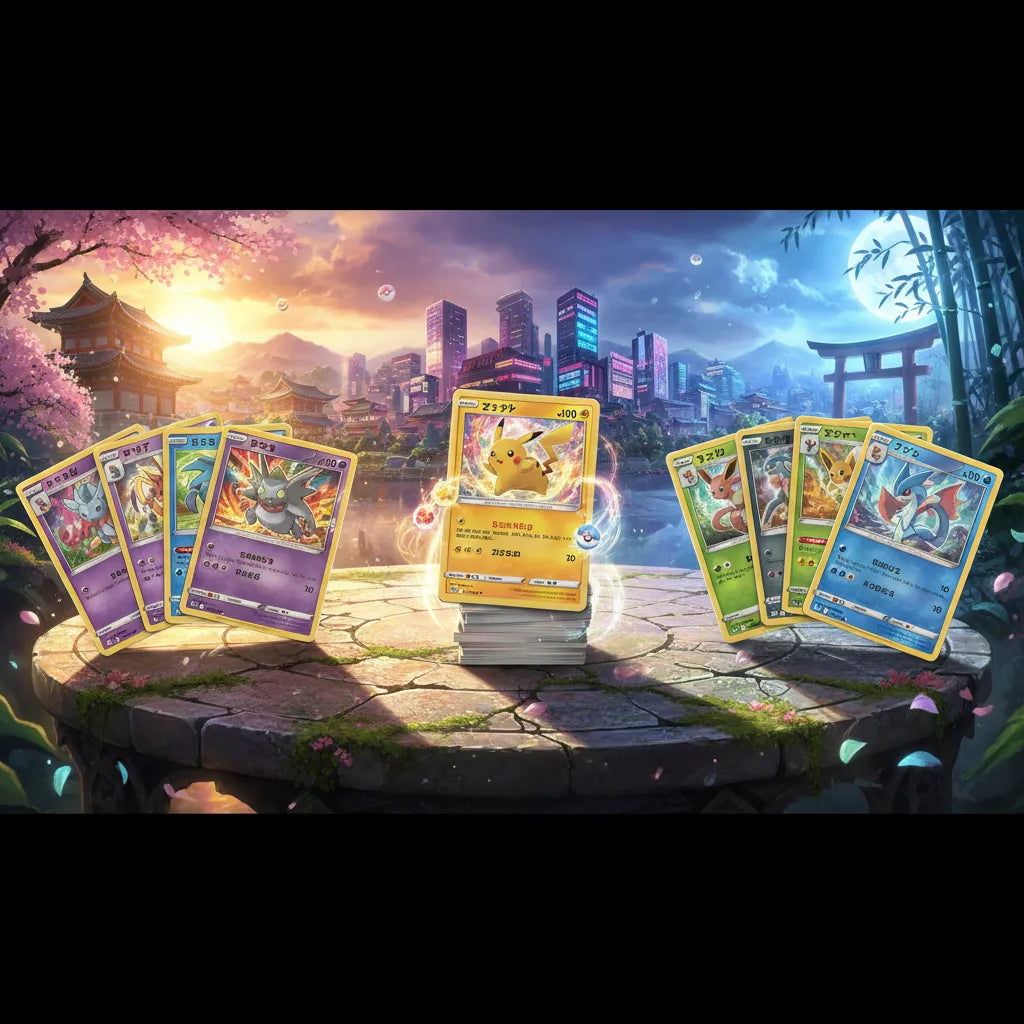
- Variety & Appeal: International Pokémon cards offer unique collecting experiences and designs.
- Quality Differences: Japanese cards are often considered the gold standard, but Korean and Chinese versions also offer high quality.
- Price & Availability: Korean cards are generally more affordable, while Japanese cards have more stable value. Chinese cards are on the rise.
- Exclusive Content: Each region offers unique promos, artworks, or even entire sets that attract collectors.
- Linguistic Immersion: Collecting in different languages enriches the hobby and connects with global fan communities.
Introduction: The Fascination of International Pokémon Cards
The world of Pokémon Trading Card Game is vast and fascinating. While many collectors and players in Europe are mainly familiar with English or German cards, Korean Pokémon cards, Chinese Pokémon cards (ZH), and Japanese Pokémon cards open up a whole new dimension of collecting. These international versions not only offer alternative language options but often also unique designs, exclusive promos, and their own market dynamics. Dive into the rich culture and specific characteristics of these regional releases to elevate your collection to a global level. Discover the subtle yet crucial differences that make each of these editions so special.
Korean Pokémon Cards: Features and Specialties
Korean Pokémon cards have become an increasingly popular option for collectors in recent years, especially for those looking for a more cost-effective alternative to Japanese or English versions without sacrificing quality. They are known for their good value for money and often offer excellent print quality that is very close to Japanese. The Korean market is dynamic and regularly releases new sets, often appearing promptly with Japanese releases. This makes them an attractive choice for collectors who want to get their hands on new cards early.
Another advantage of Korean Pokémon cards lies in their accessibility. While availability in Europe may still be somewhat lower compared to Japanese cards, it is steadily growing. Many online retailers, including DeckDynastie, offer a wide range of Korean products, from Booster Displays to special collections. The language itself, Korean, adds an exotic touch to the cards and makes them a unique part of any collection. For budget collectors or those who want to collect the widest possible range of cards, Korean editions are an excellent choice.
As an example, let's consider a typical Korean Pokémon card, such as the popular Pikachu:
| Statistic | Value |
|---|---|
| Name | Pikachu |
| Type | Lightning |
| Basic Pokémon | Yes |
| HP | 60 |
| Ability | --- |
| Attack 1 | Quick Attack (1 Lightning Energy, 1 Colorless Energy): Flip a coin. If heads, this attack does 20 damage. If tails, 10 damage. |
| Weakness | Fighting (x2) |
| Resistance | --- |
| Retreat Cost | 1 Colorless Energy |
| Set Code |
S12a (VSTAR Universe) |
This card is a classic example of the detailed design and clear layouts you can expect from Korean Pokémon cards. The Korean script gives the card a special aesthetic that stands out from the more familiar Latin characters, making it a real eye-catcher in any collection. Discover the variety and quality of Korean releases in our collection of Korean Pokémon cards.
Chinese (ZH) Pokémon Cards: What Makes Them Stand Out
Chinese Pokémon cards, often marked with 'ZH' (for the Chinese language), represent a relatively young but rapidly growing market in the Pokémon TCG universe. The official launch of the trading card game in mainland China only happened in 2022, making this market one of the newest major players. This means that Chinese cards occupy a unique position: they are not yet as widespread as Japanese or Korean cards but are rapidly gaining importance and popularity. The print quality of Chinese cards is remarkable and has steadily improved since the first releases, often at a level comparable to Korean cards.
A special feature of Chinese Pokémon cards are the sometimes unique artworks or promo cards designed specifically for the Chinese market. This exclusivity makes them particularly attractive to collectors looking for rare and distinctive pieces. The introduction of the Pokémon TCG in China has also opened up a huge new player base, which greatly increases the potential for future developments and collector value of these cards. For collectors who like to invest in new markets or aim for a truly complete "World Collection," Chinese cards are a must. The language, Simplified Chinese, also offers a fascinating aesthetic variety.
As an example of a Chinese Pokémon card, let's consider the majestic Charizard:
| Statistic | Value |
|---|---|
| Name | Charizard |
| Type | Fire |
| Stage | Stage 2 (evolves from Charmeleon) |
| HP | 160 |
| Ability | Inferno (Once per turn, if this Pokémon is your Active Pokémon, you may attach a Fire Energy card from your hand to this Pokémon.) |
| Attack 1 | Fire Spin (3 Fire Energy, 1 Colorless Energy): 130 damage. Discard 2 Energy cards attached to this Pokémon. |
| Weakness | Water (x2) |
| Resistance | --- |
| Retreat Cost | 3 Colorless Energy |
| Set Code |
S-CH (Paradox Rift) |
This card shows the impressive design you can expect from Chinese Pokémon cards. The Chinese characters give the card a special authenticity and make it a valuable piece for collectors who appreciate the global diversity of the Pokémon TCG. Discover the emerging world of Chinese releases in our collection of Chinese Pokémon cards.
Japanese Pokémon Cards: The Gold Standard?
Japanese Pokémon cards are considered the "gold standard" by many collectors and players worldwide. This is due to several factors: consistently high print quality, often superior to other regions, the premium feel of the cards, and the fact that Japan is the origin of the Pokémon franchise. Japanese sets are usually released first, meaning collectors and players can get their hands on the latest cards and mechanics here first. This often leads to higher collector value and greater demand for Japanese singles and Sealed Products.
Japanese releases are also characterized by an enormous variety of promo cards and special editions, which often feature exclusive artworks or unique holographic patterns. These promos are often only available through special events, magazines, or as bonuses for certain purchases, making them particularly sought after. The community around Japanese Pokémon cards is huge and globally connected, which facilitates trading and information gathering. For collectors who value the highest quality, exclusivity, and the origin of the game, Japanese cards are the first choice.
Let's take a powerful Japanese Pokémon card as an example, such as Mewtwo V:
| Statistic | Value |
|---|---|
| Name | Mewtwo V |
| Type | Psychic |
| Basic Pokémon V | Yes |
| HP | 210 |
| Attack 1 | Energy Burst (1 Psychic Energy): Does 20 damage times the amount of Energy attached to all of your Pokémon. |
| Attack 2 | Psystrike (2 Psychic Energy, 1 Colorless Energy): 130 damage. This attack's damage isn't affected by Resistance. |
| Weakness | Darkness (x2) |
| Resistance | Fighting (-30) |
| Retreat Cost | 2 Colorless Energy |
| Set Code |
S8a (25th Anniversary Collection) |
The detailed artworks and often glossy or textured surfaces are typical of Japanese cards and make them coveted collector's items. The clear and precise presentation of game information in Japanese is also a hallmark. For more information and products, visit our collection of Japanese Pokémon cards.
Direct Comparison: Print Quality, Price, and Availability in Europe
Comparing Korean, Chinese, and Japanese Pokémon cards is crucial for any collector looking to expand their international collection. Although all three regions offer high-quality products, there are significant differences in print quality, pricing, and general availability in Europe. These factors not only affect costs but also the collecting experience and potential resale value.
| Feature | Japanese Pokémon Cards | Korean Pokémon Cards | Chinese (ZH) Pokémon Cards |
|---|---|---|---|
| Print Quality | Excellent; often considered the gold standard. Consistently high quality, premium feel, detailed holographics and textures. | Very good; close to Japanese quality, often with similar production standards. Significant improvement in recent years. | Good to very good; emerging with steady improvement. Quality can vary, but newer sets are often at Korean levels. |
| Feel | Smooth, firm, often with a slight sheen. Excellent card thickness and rigidity. | Similar to Japanese, often slightly smoother or minimally thinner. Good thickness and durability. | Can vary, tends to a slightly "softer" feel in older sets. Newer sets feel more robust. |
| Exclusivity | Many unique promos, special artworks, and early set releases. Often the source of coveted Alternate Art cards. | Occasional exclusive promos or box designs, but less than Japan. Focus on value for money. | Growing market with the potential for unique artworks and promos, as the market is still young. |
| Price (in Europe) | Highest; due to high demand, import costs, and collector value. Singles and Sealed Products are often more expensive. | Lowest; offer the best value for money. More affordable entry into international collections. | Medium to high; still developing, prices can fluctuate greatly. Rising demand leads to higher prices for certain products. |
| Availability (in Europe) | Very good; wide range from specialized retailers and online shops. Imports are established. | Good; increasingly better, many retailers carry Korean products. Less selection than Japan, but solid. | Limited to good; still developing, but growing fast. Fewer retailers carry ZH products, but the trend is increasing. |
| Language | Japanese | Korean | Simplified Chinese (ZH) |
Print quality is a frequently discussed topic. Japanese cards have a reputation for offering the best quality, with precise cuts, vibrant colors, and a superior feel. Korean cards come very close and are often barely distinguishable from Japanese, especially with newer releases. Chinese cards have made enormous progress in recent years and can match the quality of Korean cards, although there were slight quality differences in very early releases.
In terms of price, Korean cards are generally the most affordable option. This makes them ideal for collectors on a smaller budget or for those who want to open a large quantity of Sealed Products. Japanese cards are usually the most expensive option due to their high demand, collector value, and production costs. Chinese cards are often priced between Korean and Japanese cards, with prices varying greatly depending on the set and exclusivity.
Availability in Europe is best for Japanese cards, as the market has been established the longest and many import channels exist. Korean cards are also readily available and are offered by an increasing number of retailers. Chinese cards are still rarer on the European market, but availability is steadily increasing as the market in China grows and opens internationally. DeckDynastie strives to offer a wide selection from all three regions to meet the needs of all collectors. An example of a sought-after Japanese product is the Pokémon Japanese VSTAR Universe Booster Box, which often offers excellent pull rates.
Exclusive Sets and Unique Pull Rates
One of the most exciting aspects of collecting international Pokémon cards is the discovery of exclusive sets, promo cards, and variations in "pull rates" – the probability of drawing rare cards. Each region has its own strategy for release and distribution, leading to a unique collecting experience.
-
Japanese Exclusivity:
- Early Releases: Japanese sets almost always appear first and often set the standard for upcoming international releases.
- Unique Promos: Japan is famous for its abundance of exclusive promo cards, often available at tournaments, through magazine subscriptions, or as purchase bonuses. These promos can have unique artworks or holographic effects not found anywhere else. A well-known example is the Pokémon Japanese Pikachu VMAX Promo.
- Special Boxes and Collections: There are often special box sets or collections available only in Japan that contain unique cards or accessories.
- Pull Rates: Japanese Booster Displays are known for their consistent pull rates. You can often expect guaranteed rarities per box, which makes opening very predictable and satisfying.
-
Korean Uniqueness:
- Affordable Alternatives: Korean sets often offer a more budget-friendly way to get the same or similar cards as in Japan.
- Slightly Different Set Structures: Sometimes Japanese sets are re-mixed or released in a different order in Korea, which can lead to slightly different set lists.
- Own Promos: Although rarer than in Japan, Korea also has exclusive promo cards or special box designs available only there.
- Pull Rates: Korean pull rates can differ from Japanese ones. There are reports that they are sometimes a bit "stricter," but this can vary from set to set. However, they are often still very fair and offer a good chance of rare cards. An example of this would be the Pokémon Korean Scarlet & Violet Booster Box.
-
Chinese (ZH) Specialties:
- Unique Development: As a relatively new market, Chinese sets can take their own development paths. There are already examples of unique artworks or even entire cards created specifically for the Chinese market.
- Cultural Adaptations: Sometimes artworks or card texts are adapted to meet cultural nuances or censorship requirements, leading to unique variants.
- Pull Rates: Since the market is still young, pull rates in Chinese sets are still subject to observation and analysis. They can differ from other regions and offer collectors the opportunity to discover something new. The Pokémon Chinese Paradox Rift Booster Box is a current example.
These regional differences make collecting international Pokémon cards so exciting and multifaceted. The hunt for exclusive promos or comparing pull rates across different regions adds an extra layer of complexity and joy to the hobby.
Why Language Diversity Matters in TCG
Language diversity in the Pokémon Trading Card Game is far more than just a cosmetic deviation; it is an integral part of the global fascination of the game and collecting. For many collectors and players, immersing themselves in cards in Korean, Chinese, or Japanese opens up a deeper connection to the origin and the various cultures that encompass the Pokémon franchise. It's not just about owning a card, but also about holding a piece of regional identity and aesthetics in your hands.
The different scripts – the elegant Kanji and Kana of Japanese, the flowing Hangul of Korean, or the structured Hanzi of Chinese – give the cards a unique visual appeal. They are works of art in themselves and tell a story about the global reach of Pokémon. Collecting in different languages can also have an educational component, encouraging collectors to engage with new scripts and language sounds, even if only passively.
Furthermore, language diversity fosters a broader and more inclusive community. Players and collectors from all over the world can exchange ideas about their common interests, regardless of which language versions they prefer. It reinforces the idea that Pokémon is a universal phenomenon that transcends language barriers. For tournament players, understanding texts in different languages can also offer strategic advantages, as they can better prepare for international metas. Ultimately, language diversity enriches the Pokémon TCG by adding depth, cultural richness, and boundless collecting passion to the hobby.
Find Your Next International Pokémon Collection at DeckDynastie
The world of international Pokémon cards is rich in variety, beauty, and unique collecting opportunities. Whether you are interested in the cost-effective quality of Korean sets, the emerging exclusivity of Chinese releases, or the established gold standard of Japanese cards – at DeckDynastie, you will find a carefully curated selection. We understand the passion behind collecting these unique pieces and are proud to give you access to the latest and most sought-after international Pokémon TCG products.
Dive into the exciting world of non-English Pokémon cards and discover treasures that will elevate your collection to a new level. From rare promos to full Booster Displays, our product range is continuously expanded to meet the needs of all collectors. Take the opportunity to enrich your collection with cards that not everyone has, and experience the joy of discovering new artworks and regional peculiarities. Start your journey into the fascinating world of international Pokémon cards today and find your next collectible at DeckDynastie.


Share:
One Piece Card Game: Alle Events & Championships 2026 im Überblick
Pokémon Karten Grading: PSA, BGS, CGC & ARS im Vergleich